Workplace Brand Walls: How to Tell Your Company Story Without Creating Corporate Wallpaper
Short answer
A workplace brand wall is a physical installation communicating a company's identity, history, values, people or achievements through a deliberate combination of words, images, artefacts, materials, light and digital content. The strongest walls give one audience one clear idea rather than reproducing an entire corporate presentation along a corridor.
Key takeaways
- Choose the objective before the material. Arrival, history, culture, capability, recognition and changeable content need different walls.
- Write an editorial brief first, including what information will change within two years.
- Structure content in four levels: headline, story structure, evidence, detail.
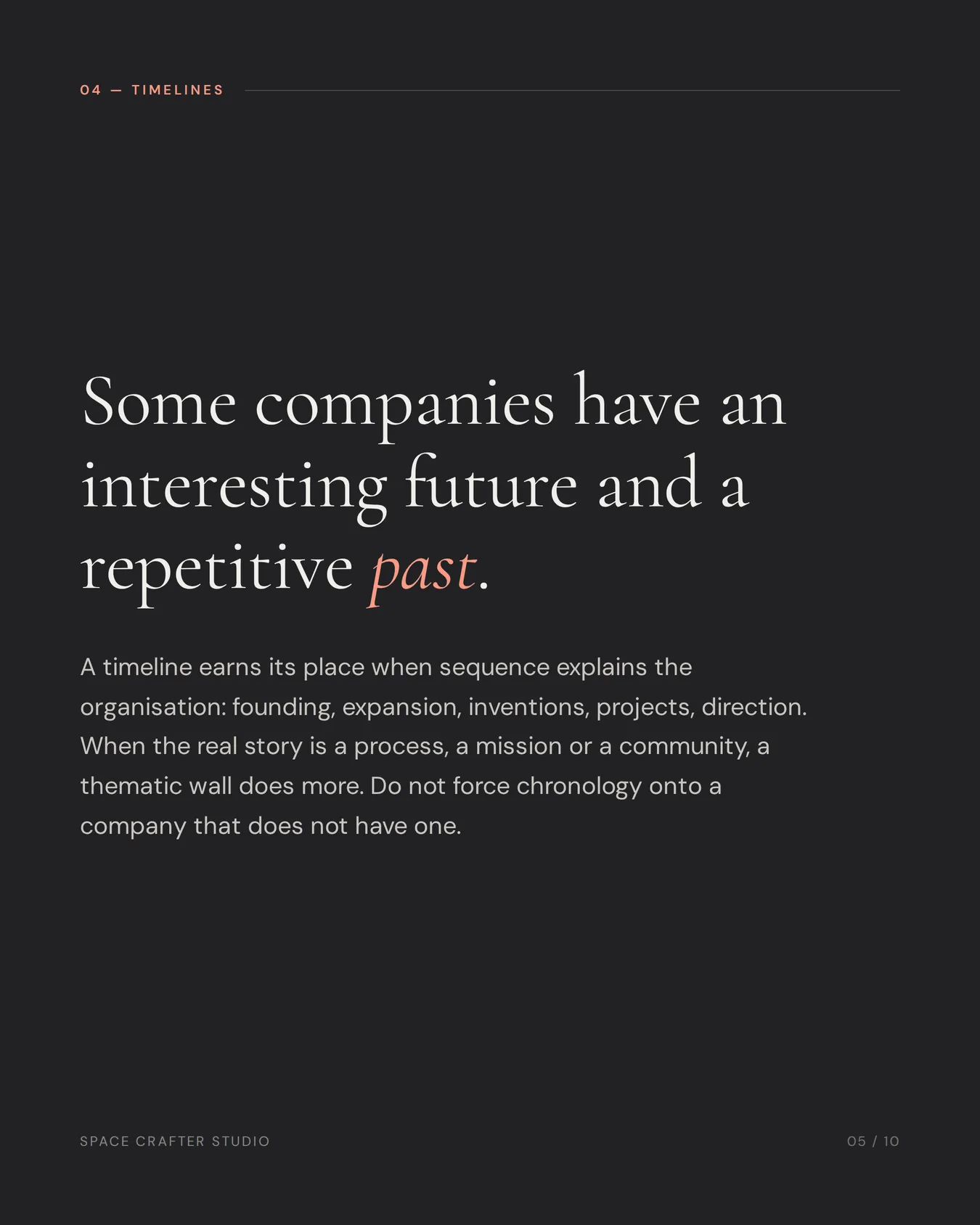
- A timeline works when sequence explains the organisation. Do not force chronology onto a company that lacks one.
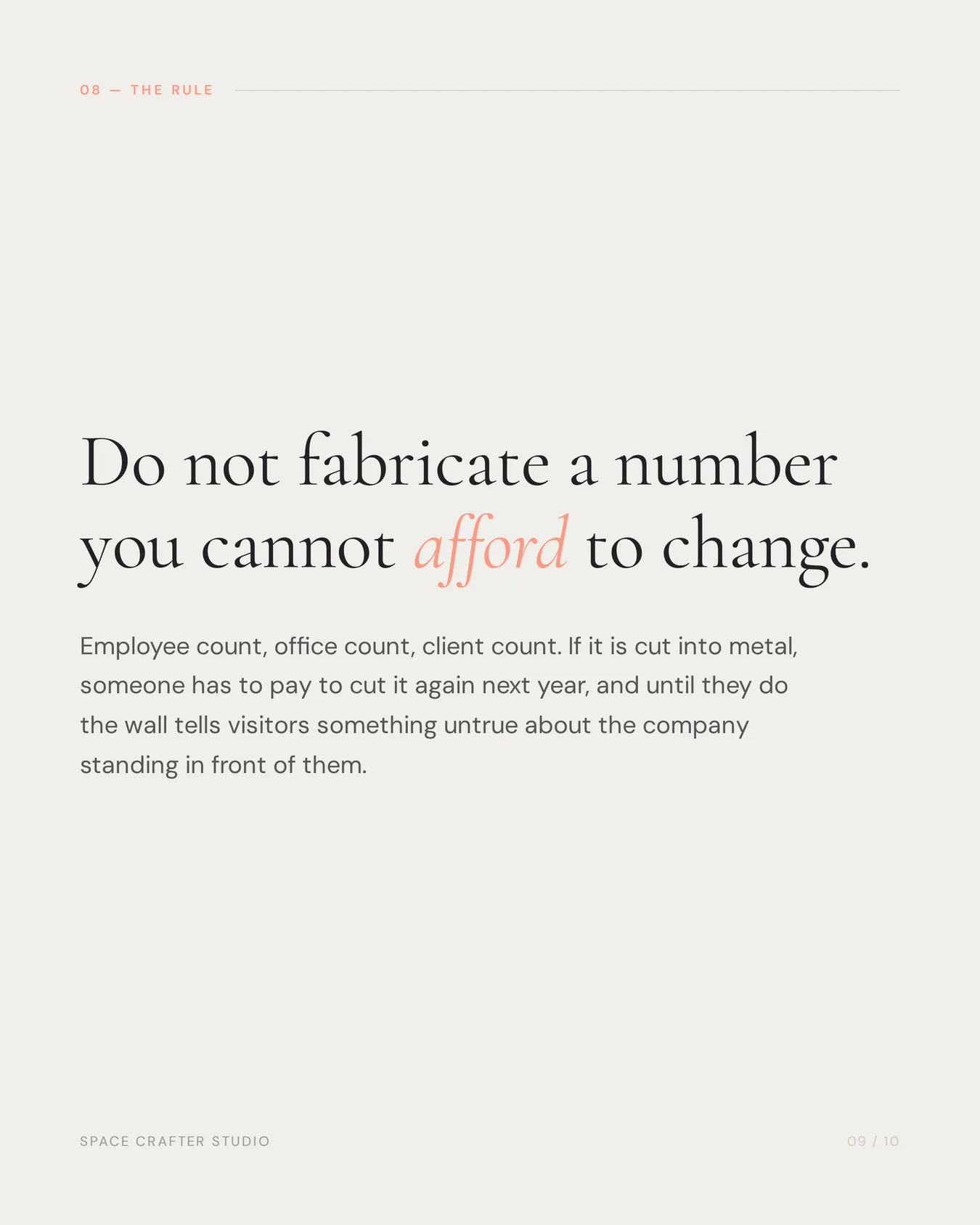
- Design updates in, and avoid fabricating a number you cannot afford to change.
A workplace brand wall is a physical installation that communicates a company’s identity, history, values, people or achievements through a deliberate combination of words, images, artefacts, materials, light and digital content. The strongest walls give one audience one clear idea; they do not paste the entire corporate presentation into a corridor.
A logo on a feature wall identifies the company. A brand wall explains something worth knowing about it.
What can a workplace brand wall do?
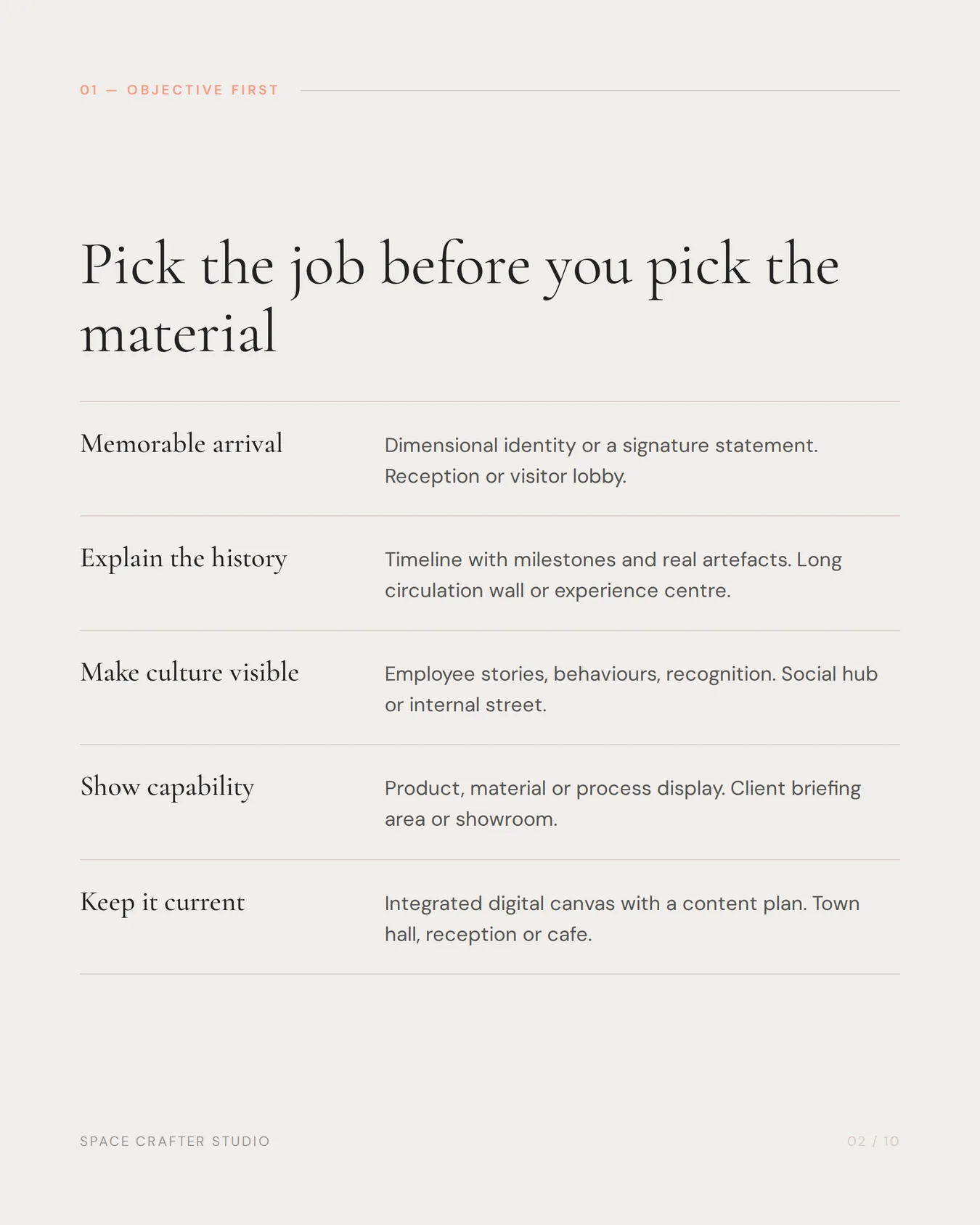
Different objectives create different walls:
| Objective | Useful format | Best location |
|---|---|---|
| Create a memorable arrival | Dimensional identity or signature brand statement | Reception or visitor lobby |
| Explain company history | Timeline with milestones and artefacts | Long circulation wall or experience centre |
| Make culture visible | Employee stories, behaviours and recognition | Social hub or internal street |
| Demonstrate capability | Product, material or process display | Client briefing area or showroom |
| Recognise people | Awards, patents, founders or team achievements | Shared workplace destination |
| Keep content current | Integrated digital canvas with a content plan | Town hall, reception or café |
Choose the objective before choosing the material.
Start with an editorial brief
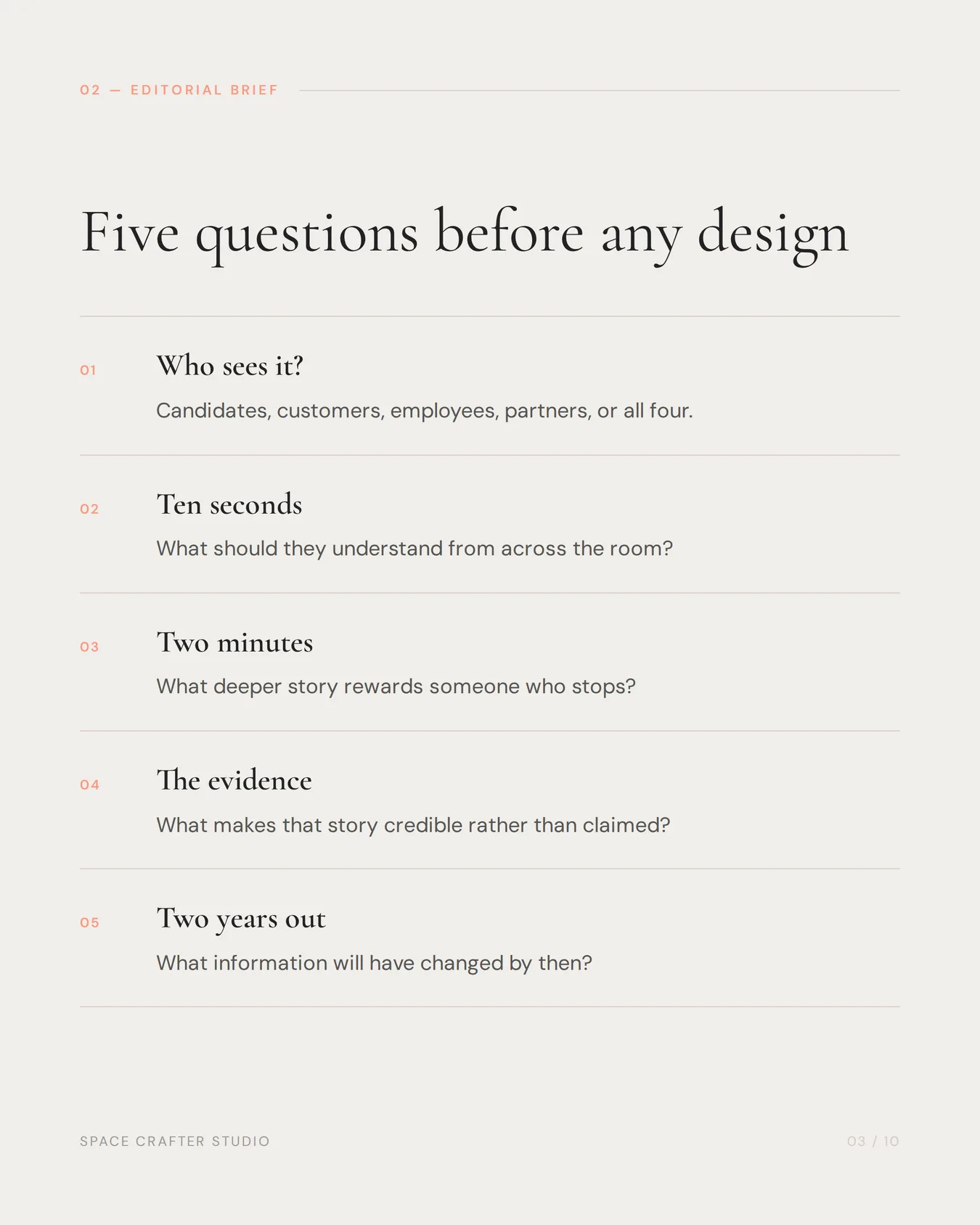
Answer five questions:
- Who will see the wall—candidates, customers, employees, partners or all four?
- What should they understand in ten seconds?
- What deeper story should reward a two-minute look?
- What evidence makes that story credible?
- What information will change within the next two years?
That final question separates fixed content from updateable content before fabrication.
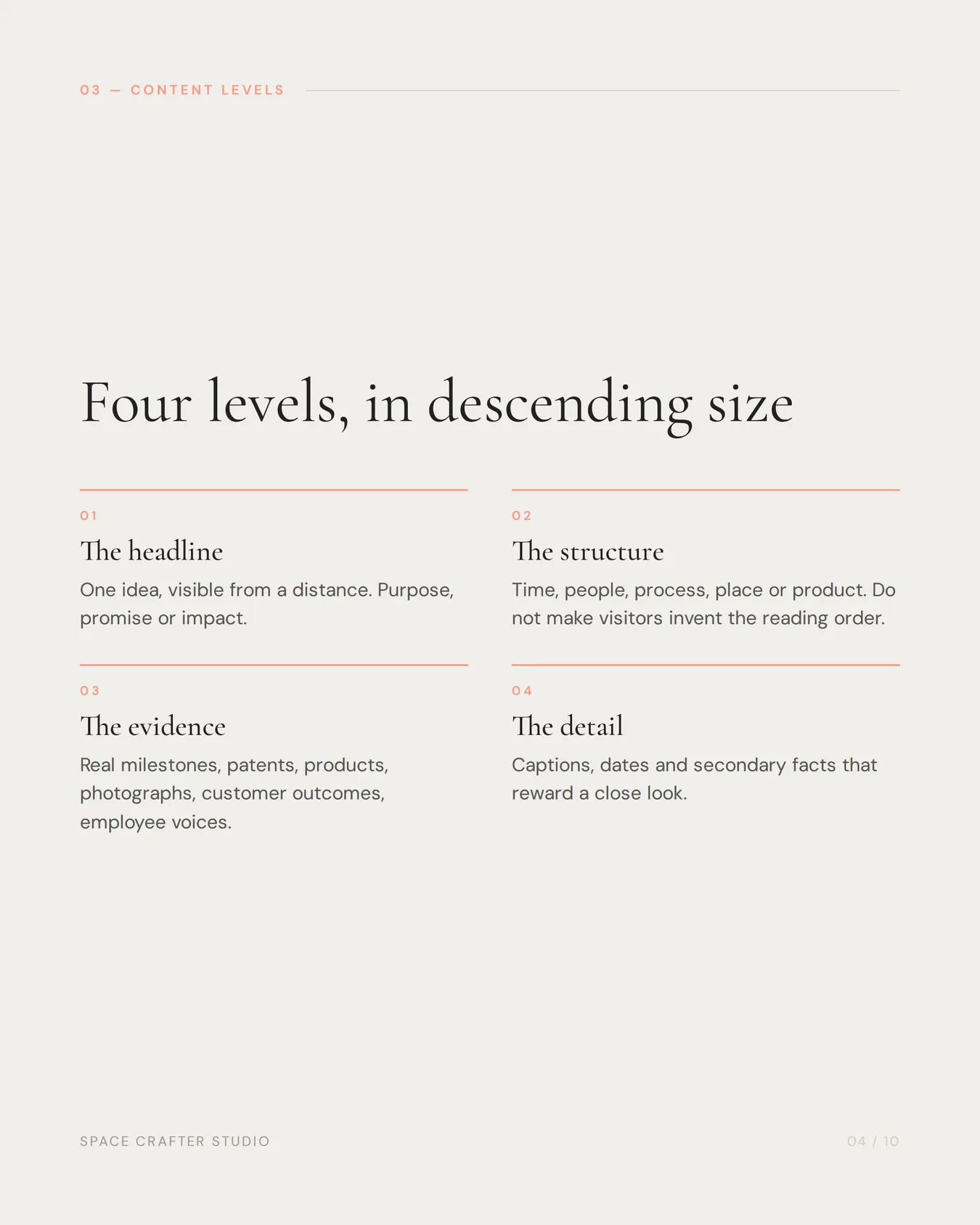
The four levels of content
1. The headline
One idea visible from a distance. It might be the brand purpose, a defining promise or a clear statement of impact.
2. The story structure
Organise the wall around a simple logic: time, people, process, place, product or challenge. Do not make the visitor invent the reading order.
3. The evidence
Use real milestones, patents, products, materials, photographs, customer outcomes, employee voices or archival objects. Specific evidence is more persuasive than another paragraph about “innovation.”
4. The detail
Captions, dates and secondary facts should reward close viewing without controlling the whole composition.
Timeline wall or brand wall?
A timeline is appropriate when sequence explains the organisation: founding, expansion, inventions, projects and future direction. A thematic wall is stronger when the central story is a process, mission, portfolio or community rather than chronology.
Do not force every company into a timeline. Some organisations have an interesting future and a repetitive past.
How long should the copy be?
Short enough to read in the place where it is installed. A busy reception is not a museum gallery, and a corridor visitor is usually moving.
Use:
- a clear headline;
- short milestone or theme labels;
- concise captions;
- numbers only when their meaning is obvious; and
- optional deeper content through digital media or links.
Edit the copy at full scale. Text that seems brief in a document may become a wall of words once enlarged.
Which materials work for brand walls?
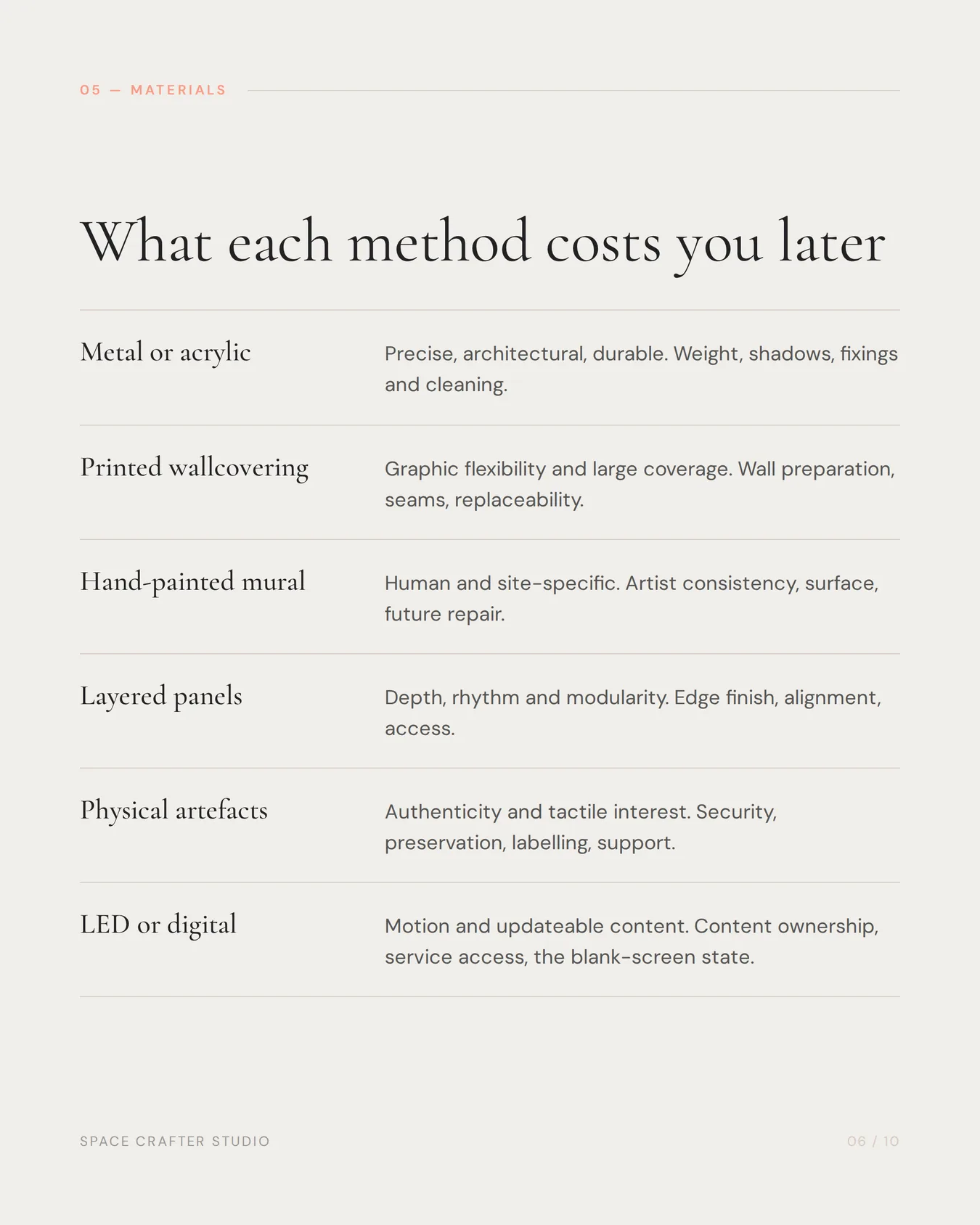
| Material or method | Character | Considerations |
|---|---|---|
| Dimensional metal or acrylic | Precise, architectural and durable | Weight, shadows, fixings and cleaning |
| Printed wallcovering or vinyl | Graphic flexibility and large coverage | Wall preparation, seams and replaceability |
| Hand-painted mural | Human, site-specific and expressive | Artist consistency, surface and future repair |
| Layered panels | Depth, rhythm and modularity | Edge finish, alignment and access |
| Lightbox or illumination | High visual focus | Power, heat, access and brightness |
| Physical artefacts | Authenticity and tactile interest | Security, preservation, labelling and support |
| LED or digital display | Motion and updateable content | Content ownership, service access and acoustic/visual impact |
Mix materials only when each supports the narrative. Variety without hierarchy turns the wall into a sample catalogue.
Where should a brand wall go?
Choose a location based on viewing behaviour:
- Reception: strong first impression, shorter dwell time, frequent photography.
- Corridor: sequential storytelling, but moving viewers and narrow sightlines.
- Town hall: strong employee relevance and digital-content potential.
- Café or social hub: relaxed dwell time and recurring internal audience.
- Client centre: deeper proof of capability and guided storytelling.
Check glare, furniture, queues, doors, sprinklers, screens and future changes before fixing the composition.
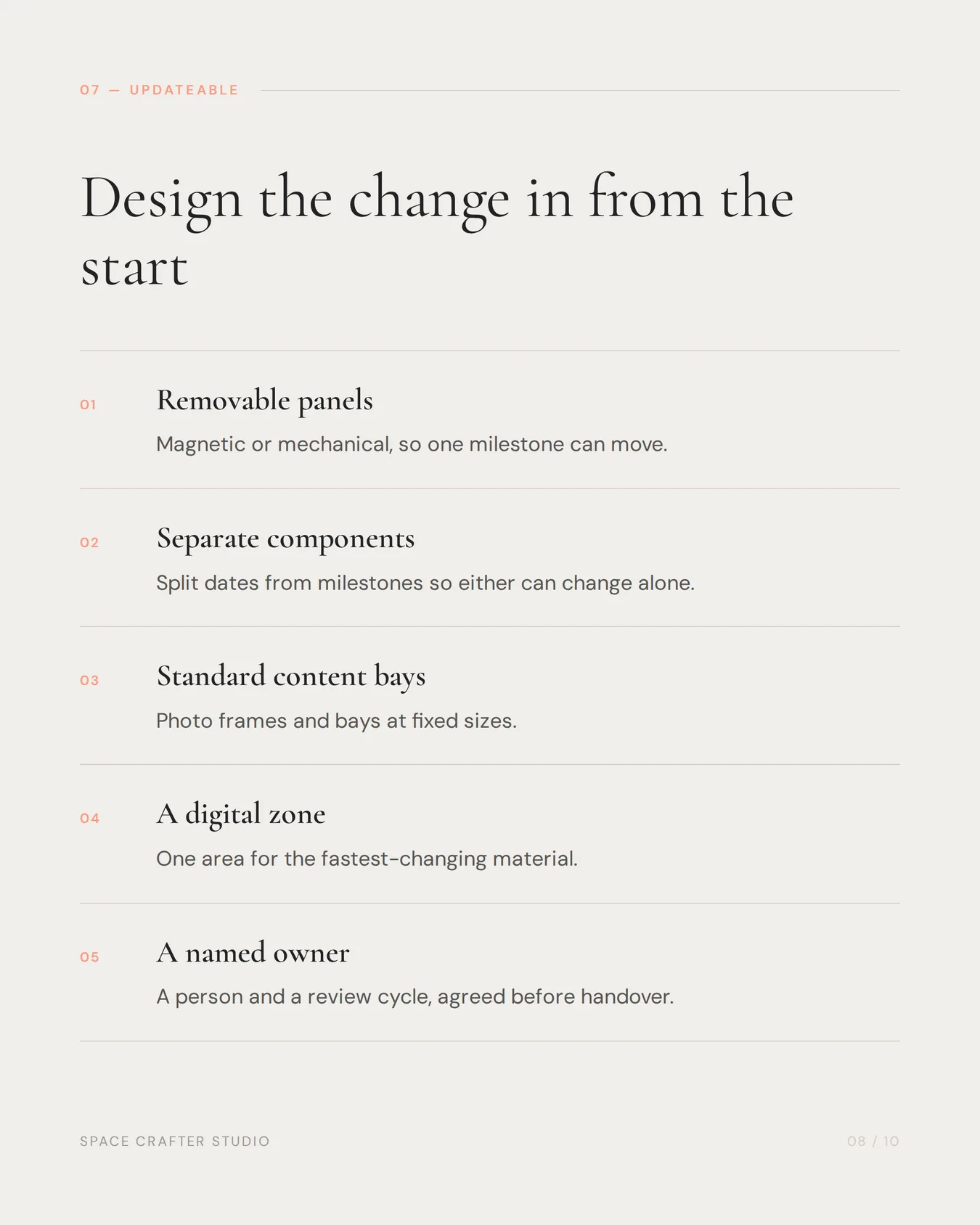
How do you make the wall easy to update?
Design change into the system:
- removable magnetic or mechanical panels;
- separate date and milestone components;
- standard photo frames or content bays;
- accessible graphic skins;
- a digital zone for fast-changing material; and
- a content owner and review cycle.
Do not make a permanent dimensional claim such as employee count or office count unless it can be replaced economically.
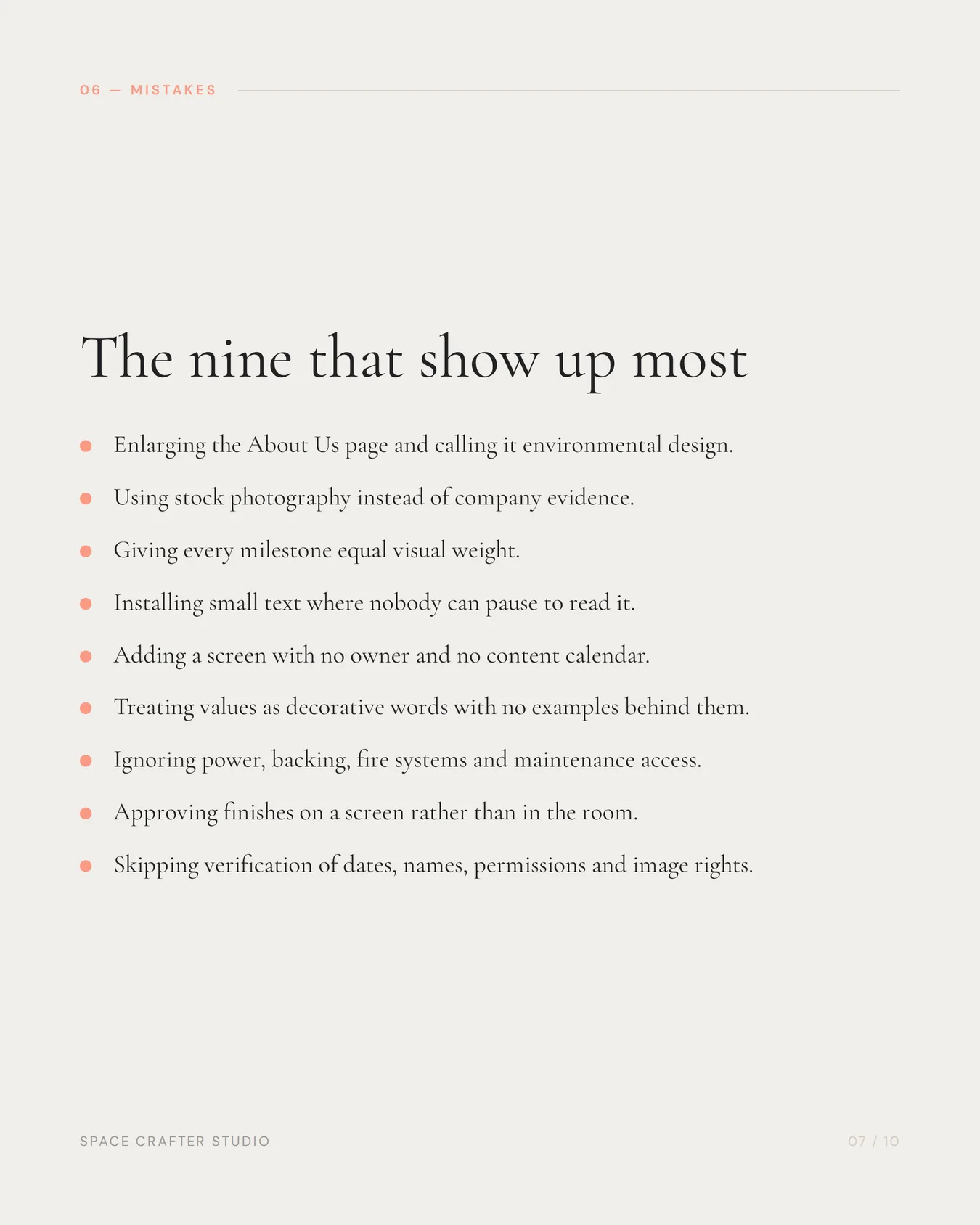
Brand-wall mistakes to avoid
- Enlarging the “About us” webpage and calling it environmental design.
- Using generic stock photographs instead of company evidence.
- Giving every milestone equal visual weight.
- Installing small text where people cannot pause.
- Adding a screen without an owner or content calendar.
- Treating values as decorative words without examples.
- Ignoring power, backing, fire systems and maintenance access.
- Approving finishes only on a screen.
- Forgetting to verify dates, names, permissions and image rights.
A practical project process
- Interview brand, leadership, people and operations stakeholders.
- Gather and verify archival material.
- Write the editorial brief and content hierarchy.
- Survey the wall, sightlines, lighting and services.
- Develop two or three spatial story directions.
- Edit and proof the final content.
- Build material, colour and lighting samples.
- Produce detailed drawings and coordinate interfaces.
- Fabricate, pre-assemble where possible and install.
- Photograph, document and assign future content ownership.
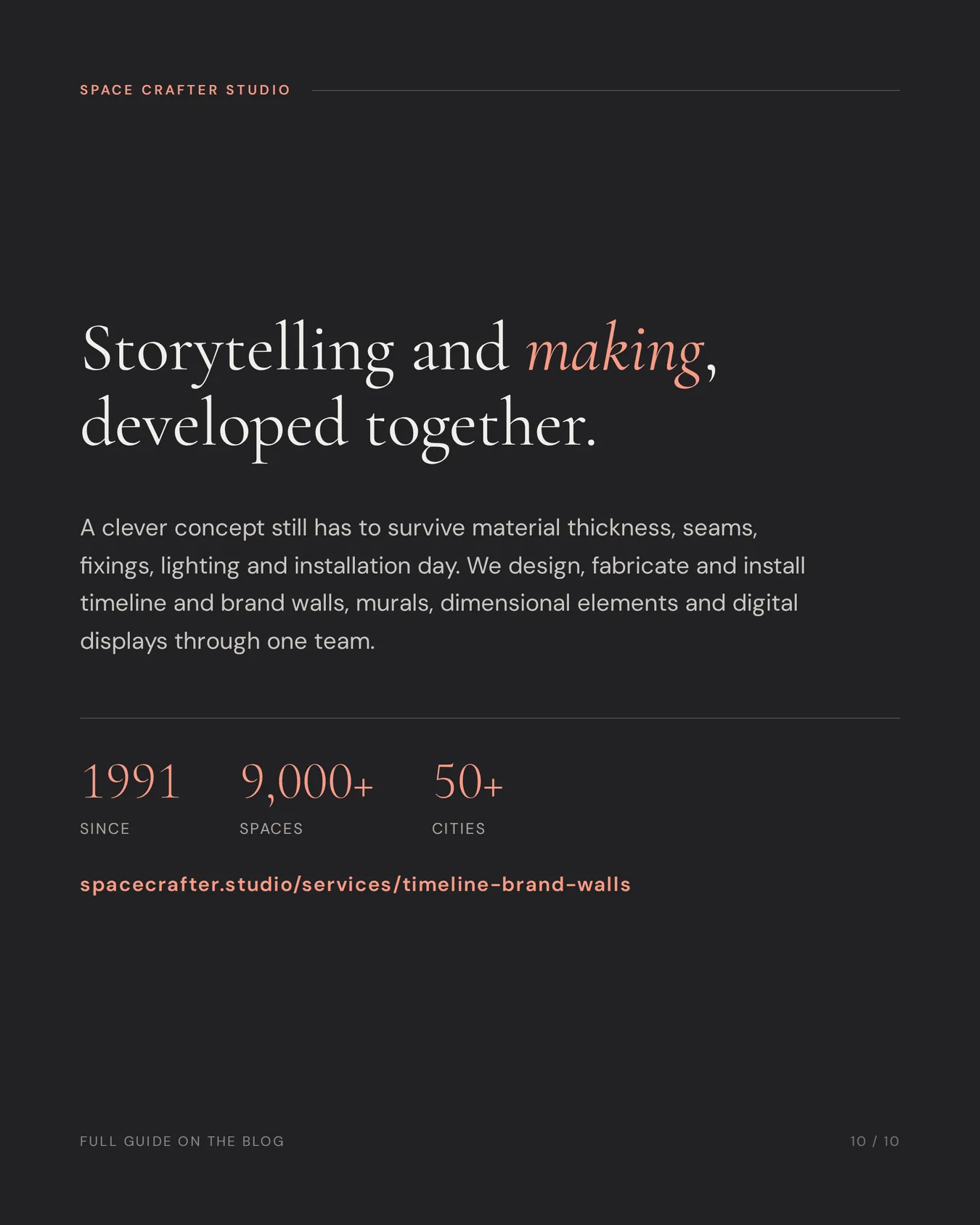
The strongest result comes when storytelling and making develop together. A clever concept must survive material thickness, seams, fixings, lighting and the reality of installation.
SpaceCrafter Studio designs, fabricates and installs timeline and brand walls, murals, wall graphics, dimensional elements and digital displays through one team. The studio has delivered commercial spaces across India since evolving from Aarkay Signs, established in 1991.
Last reviewed 2026-09-19 by the SpaceCrafter Studio Brand Environments Team. Space Crafter Studio is a unit of Kingar Signs Private Limited, Bengaluru, designing, fabricating and installing signage, wayfinding, LED walls and brand environments since 1991.