How to Roll Out Signage Across Multiple Locations Without Losing Brand Consistency
Short answer
A successful multi-location signage rollout uses one controlled design system, site-specific surveys, approved prototypes, a shared asset and message register, production quality checks and documented installation at every location. The aim is consistent brand recognition without pretending that every building, climate and approval condition is identical.
Key takeaways
- Split the system into three layers: brand standards central, sign system mostly central, engineering local by definition.
- Consistency means controlled decisions from one system, not the same sign size on every facade.
- Treat the pilot as a deliberate learning stage with documented changes before bulk release.
- Use a uniform site-survey standard and a unique site code so drawings and photographs cannot be mixed up.
- Close the programme with a living asset register covering location, type, message, warranty and service history.
A successful multi-location signage rollout uses one controlled design system, site-specific surveys, approved prototypes, a shared asset and message register, production quality checks and documented installation at every location. The aim is consistent brand recognition without pretending that every building, climate and approval condition is identical.
The operating model matters as much as the artwork. A perfect logo file cannot compensate for incorrect measurements, unknown substrates or fragmented accountability.
What should be standardised—and what should adapt?
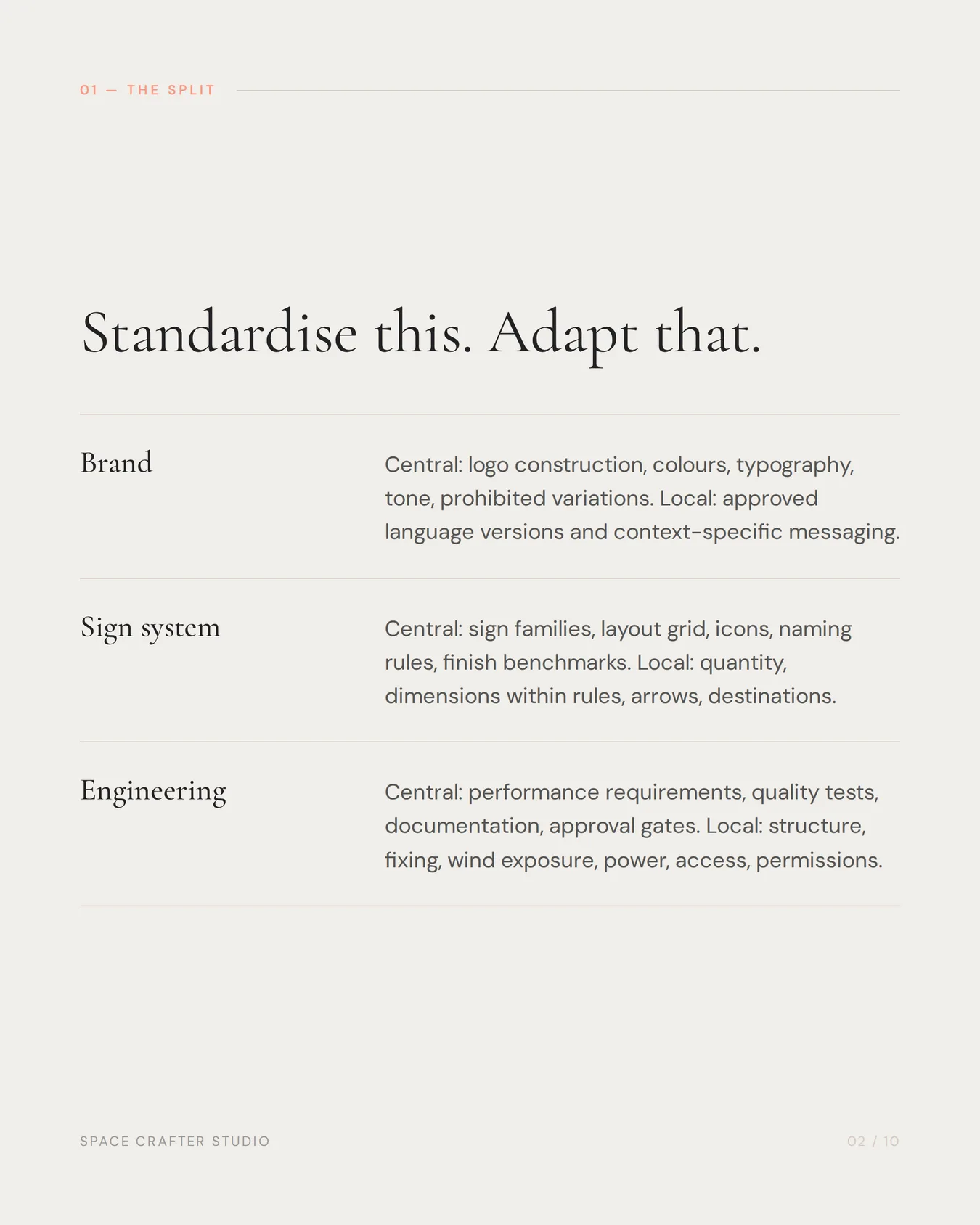
Divide the system into three layers.
| Layer | Standardise centrally | Adapt locally |
|---|---|---|
| Brand | Logo construction, colours, typography, tone and prohibited variations | Approved language versions and context-specific messaging |
| Sign system | Sign families, layout grid, icon set, naming rules and finish benchmarks | Sign quantity, dimensions within rules, arrows and destinations |
| Engineering | Performance requirements, quality tests, documentation and approval gates | Structure, fixing, wind exposure, power, access and local permissions |
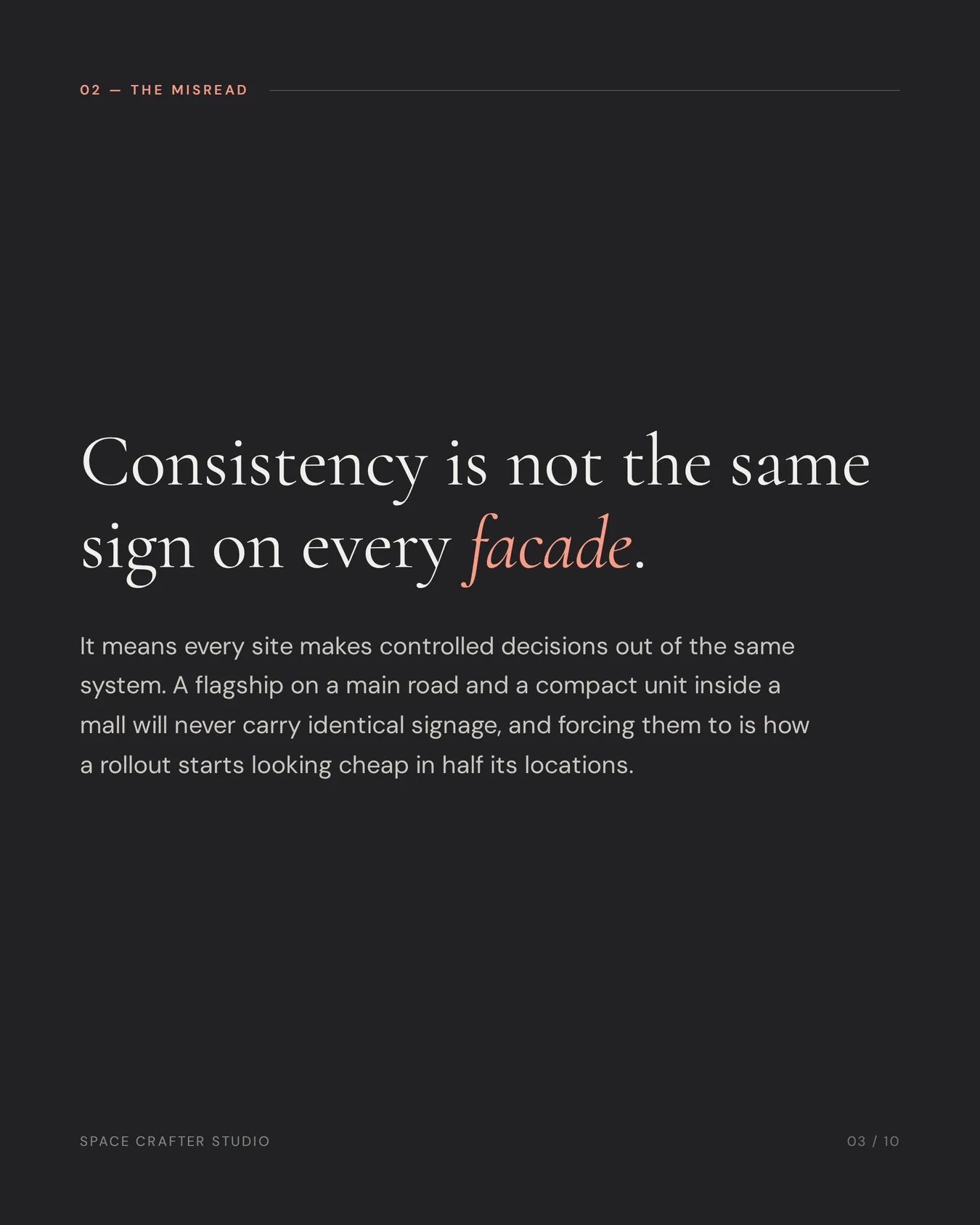
Consistency does not mean forcing the same sign size onto every facade. It means making controlled decisions from the same system.
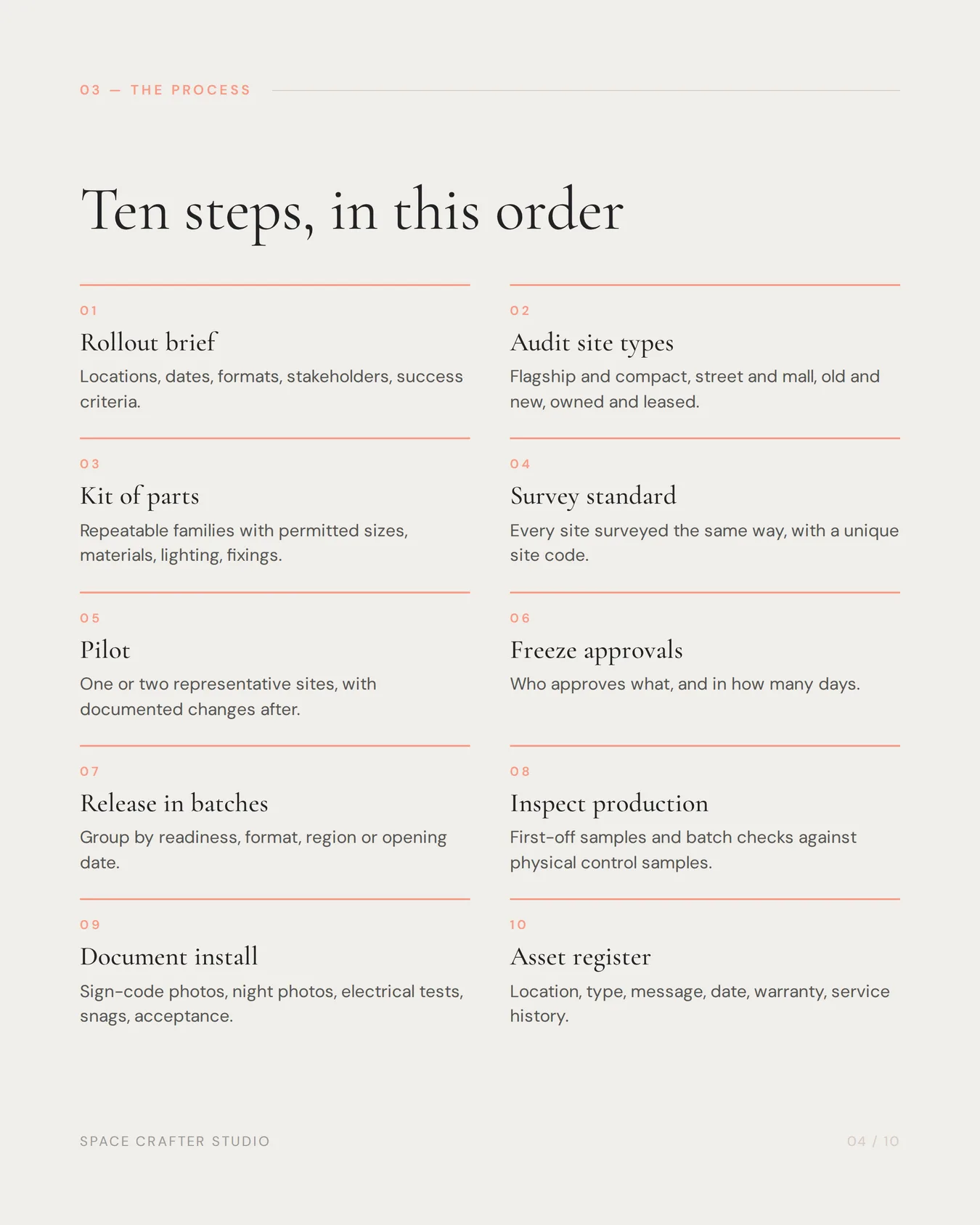
The ten-step rollout process
1. Define the rollout brief
List locations, opening dates, formats, stakeholders and success criteria. Identify which sites are live, under construction or still at lease stage. Confirm whether the programme includes exterior identity, internal navigation, statutory signs, graphics and digital displays.
2. Audit representative site types
Select a small set that captures the variation: flagship and compact sites, street and mall locations, old and new buildings, owned and leased properties, different languages and climate zones.
The system should be designed for the range, not just the easiest pilot.
3. Create a kit of parts
Build repeatable sign families and components:
- exterior letters and fascia types;
- entrance and operating-hour signs;
- wall, ceiling and projecting directionals;
- room and facility signs;
- window and wall graphics;
- digital display housings; and
- temporary or opening-soon formats.
Define permitted sizes, materials, finishes, lighting, content zones, fixings and update mechanisms.
4. Build a site-survey standard
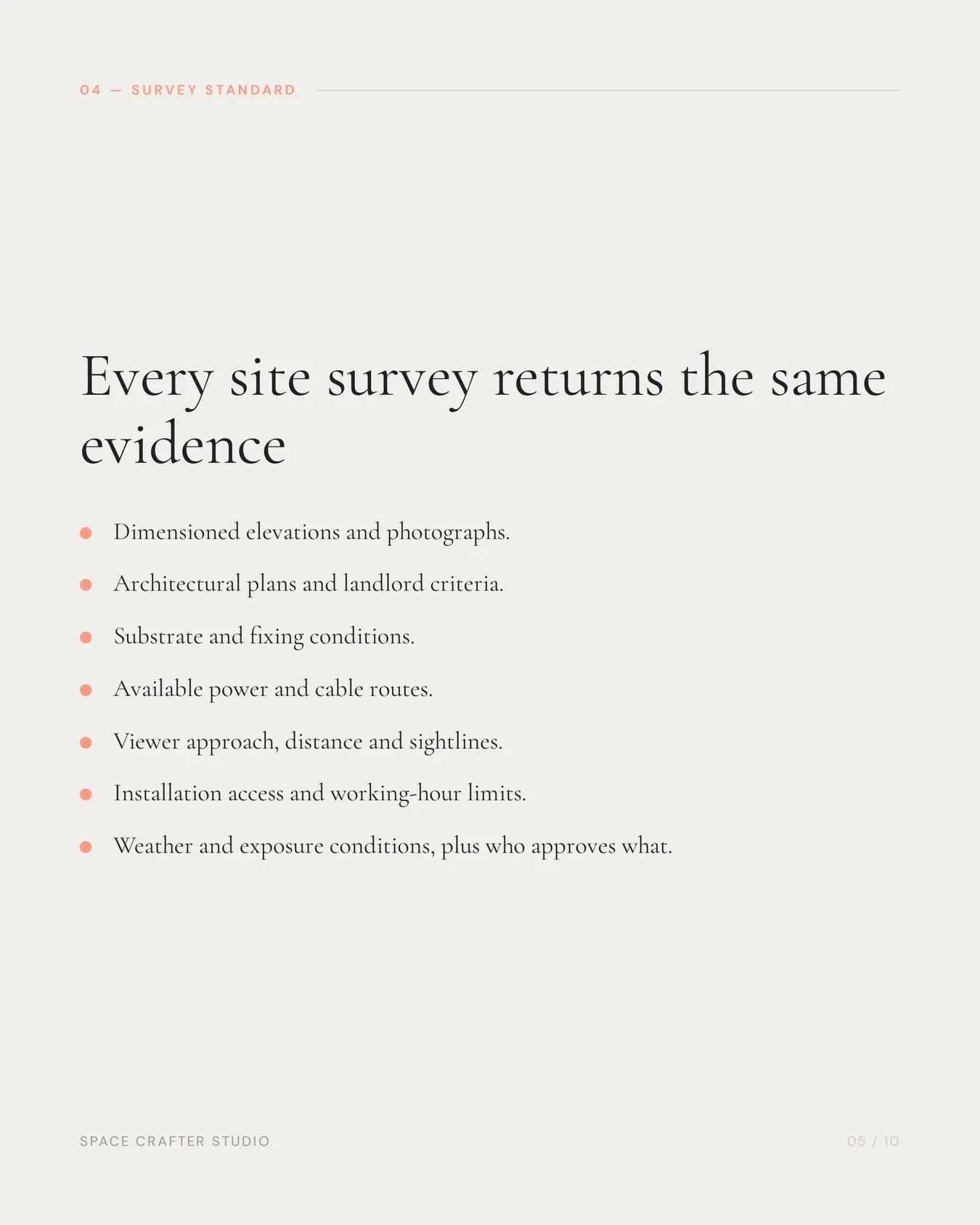
Every survey should collect the same evidence:
- dimensioned elevations and photographs;
- architectural plans and landlord criteria;
- substrate and fixing conditions;
- available power and cable routes;
- viewer approach, distance and sightlines;
- installation access and working-hour limits;
- weather and exposure conditions; and
- approval responsibilities.
Use a unique site code and revision status so photographs and drawings cannot be mixed between locations.
5. Pilot before scaling
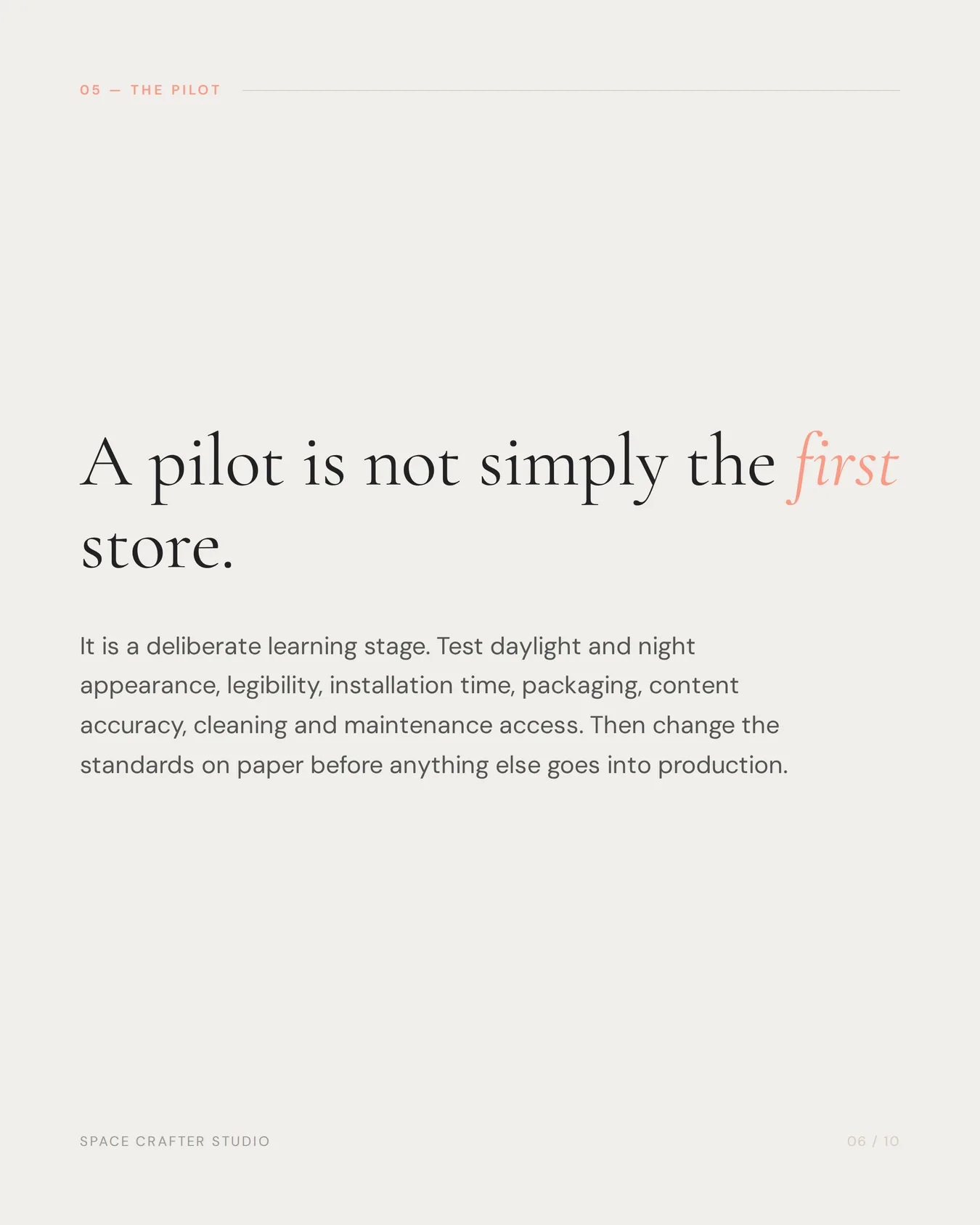
Install at one or more representative sites. Test daylight and night appearance, legibility, installation time, packaging, content accuracy, cleaning and maintenance access.
A pilot is not merely the first store. It is a deliberate learning stage with documented changes before bulk production.
6. Freeze the standards and approval matrix
State who approves brand, site adaptation, engineering, cost, landlord submissions and final installation. Set response times. A rollout stalls when every stakeholder can comment but nobody owns a decision.
7. Release sites in controlled batches
Group locations by readiness, format, region or opening date. A batch allows learning and production efficiency while limiting the number of sites exposed to an unresolved issue.
8. Inspect during production
Use first-off samples and batch quality checks for colour, dimensions, finish, illumination, wiring and packing. Photographs help, but critical finishes should have physical control samples.
9. Document installation
For each site, capture sign-code photographs, night photographs where illuminated, electrical tests, snags and client acceptance. Update drawings when site conditions force an approved change.
10. Maintain a living asset register
Record each sign’s location, type, message, installation date, warranty, electrical component and service history. This turns a one-time rollout into a maintainable programme.
One national vendor or several regional vendors?
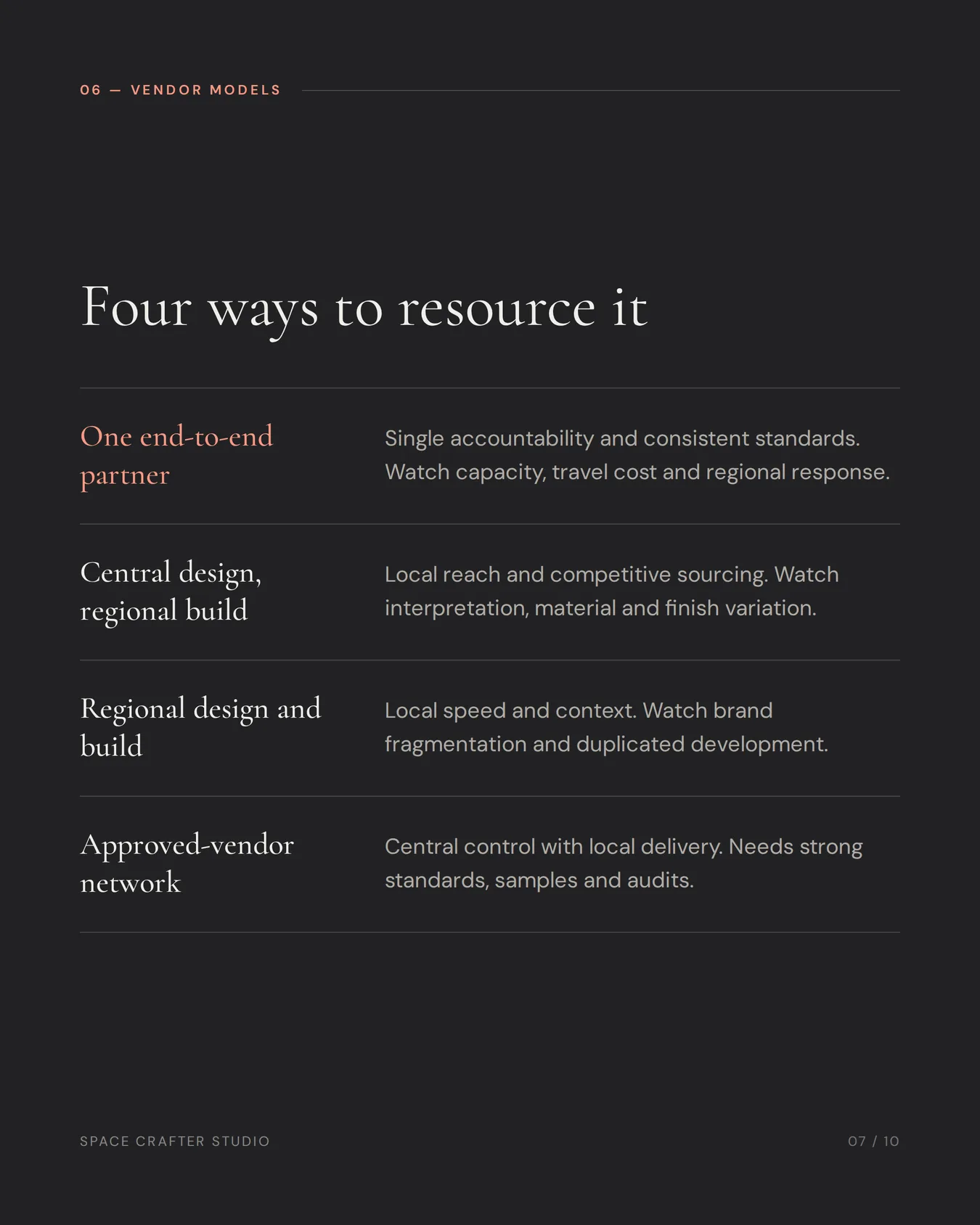
| Model | Advantages | Risks to control |
|---|---|---|
| One end-to-end partner | Single accountability, shared standards, consolidated reporting | Capacity, travel cost and regional response coverage |
| Central design with regional fabricators | Local reach and competitive sourcing | Variation in interpretation, material and finish |
| Regional design and fabrication | Local speed and contextual knowledge | Brand fragmentation and duplicate development |
| Hybrid approved-vendor network | Balance of central control and local delivery | Requires strong standards, samples and audit process |
Choose based on site count, complexity and quality risk—not on the assumption that one model is always cheaper.
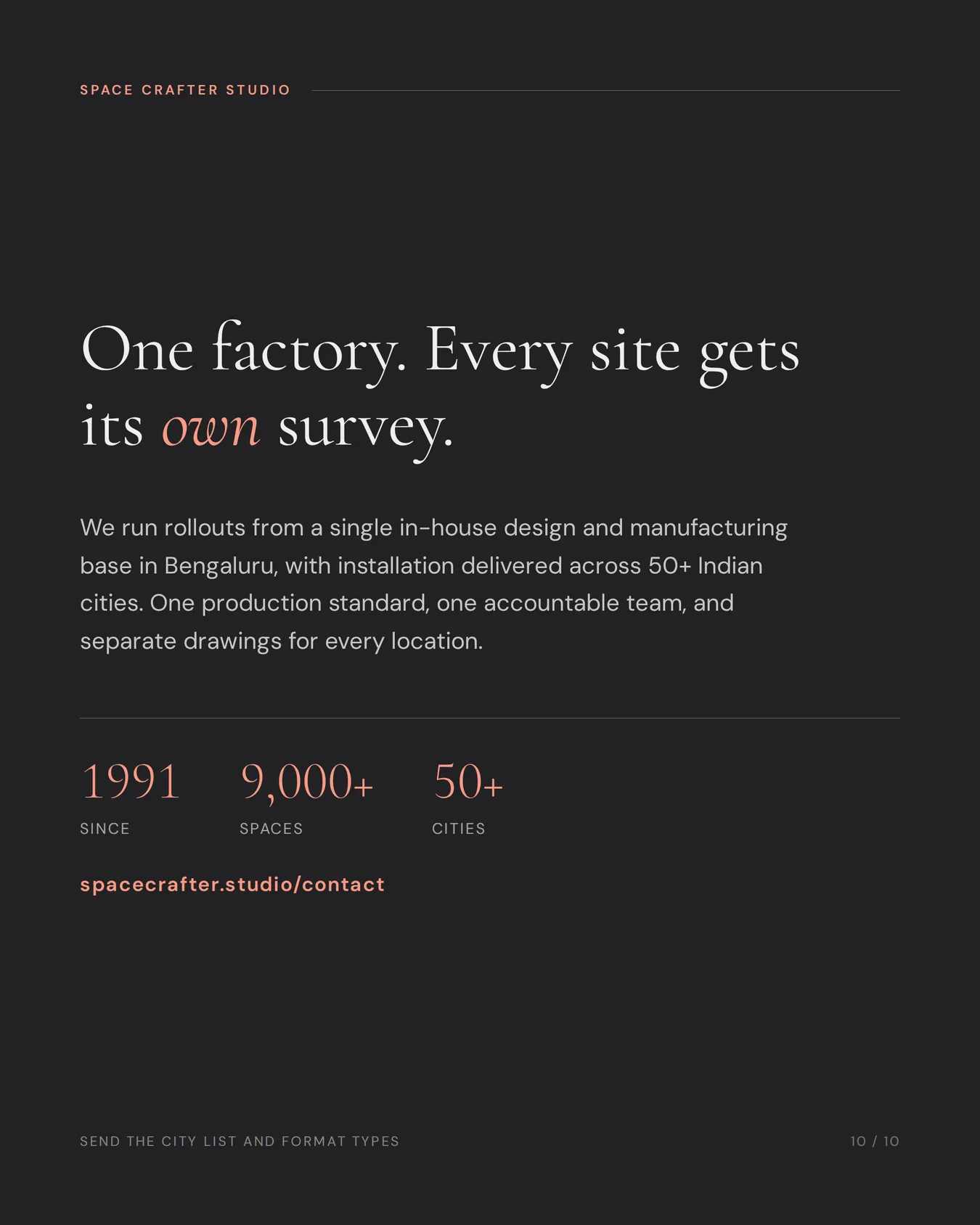
SpaceCrafter Studio uses one in-house design and manufacturing base in Bengaluru with installation delivery reported across 50+ Indian cities. That model is suited to programmes that value a consistent production standard and one accountable team, while each site still receives its own survey and production drawings.
How do you compare rollout pricing?
Separate costs into:
- system design and toolkit;
- site survey and adaptation;
- permits and landlord submissions;
- prototypes and control samples;
- fabrication by sign type;
- packing and freight;
- local civil, electrical and access works;
- installation and night work;
- project management and reporting; and
- maintenance, spares and return visits.
Then compare a representative site basket instead of isolated unit rates. A cheap standard sign can be offset by expensive surveying, freight or rework.
Common multi-site rollout failures
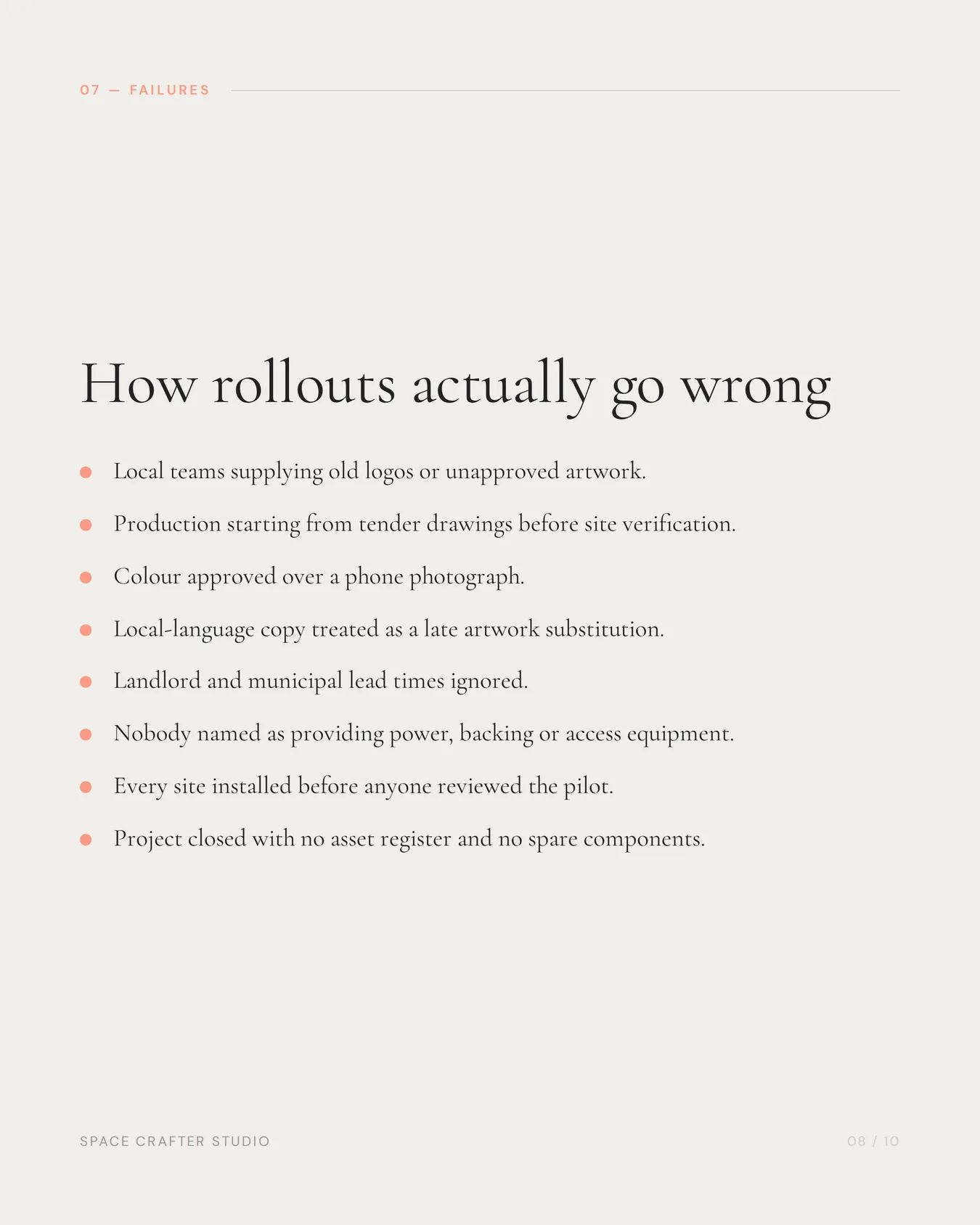
- Using old logos or unapproved artwork from local teams.
- Starting production from tender drawings before site verification.
- Approving colour through phone photographs.
- Treating local-language copy as a late artwork substitution.
- Ignoring landlord and municipal lead times.
- Failing to identify who provides power, backing and access equipment.
- Shipping fragile signs without site-specific packing and handling plans.
- Installing every site before reviewing the pilot.
- Closing the project without an asset register or spare components.
A rollout dashboard worth using
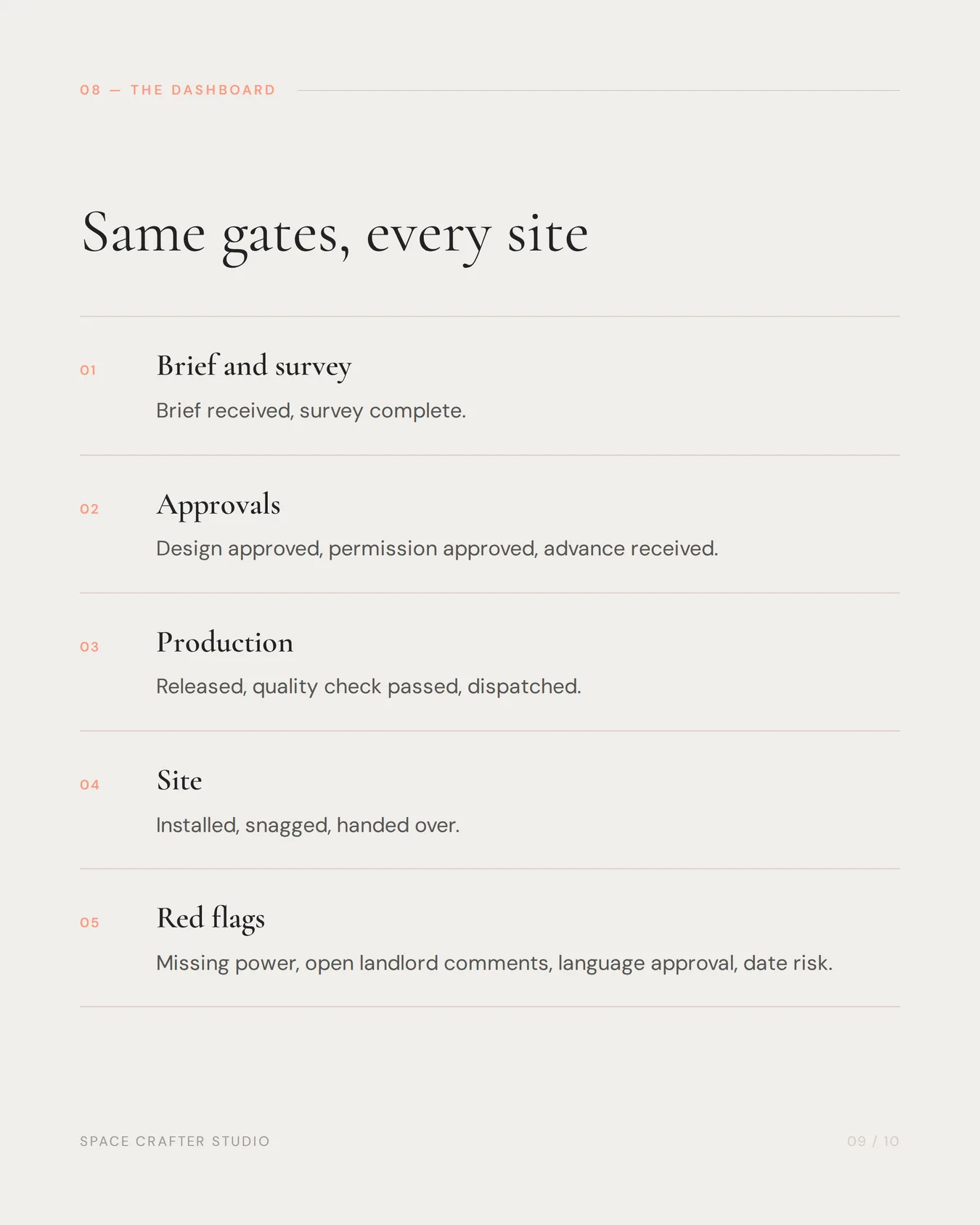
Track each site through the same gates: brief received, survey complete, design approved, permission approved, advance received, production released, quality check passed, dispatched, installed, snagged and handed over.
Add red flags for missing power, unresolved landlord comments, language approval and opening-date risk. A clear dashboard prevents urgency from bypassing quality controls.
Explore SpaceCrafter Studio’s signage and wayfinding capability or share the city list, format types and programme dates through the project contact page.
Last reviewed 2026-09-19 by the SpaceCrafter Studio Rollout Team. Space Crafter Studio is a unit of Kingar Signs Private Limited, Bengaluru, designing, fabricating and installing signage, wayfinding, LED walls and brand environments since 1991.